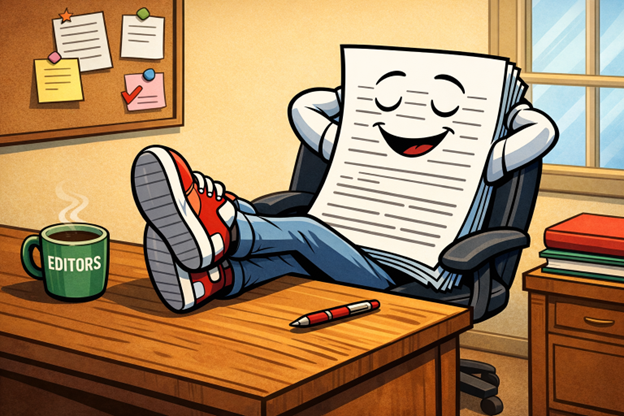
There’s a moment in almost every manuscript I edit where I can feel the author pull back. Not visibly. Not in a way you can point to and say, “Ah, yes, here is the exact sentence where courage died.” It’s subtler than that.
- The dialogue gets a little safer.
- The conflict softens just a touch.
- The character makes the reasonable choice instead of the interesting one.
Everything still works. The story is coherent. Competent, even. And that’s the problem. I call it the comfortable manuscript.
Comfortable manuscripts are technically fine. They hit the expected beats. They follow the rules. They don’t offend, don’t surprise too much, don’t risk alienating the reader. They are, in every measurable way, “good.”
And almost completely forgettable.
Writers don’t do this because they lack skill. Quite the opposite. Comfortable manuscripts are often written by capable, experienced authors who know exactly what they’re doing. Which is precisely why it happens.
At some point in the drafting or editing process, the instinct shifts from exploring the story to managing the story. From discovery to control. From risk to safety. You can see it in a few common ways.
- Dialogue that says exactly what it means, instead of what it’s trying to hide.
- Characters who choose the path that keeps them likable, instead of the one that reveals who they really are.
- Conflicts that resolve cleanly, when they should leave a bruise.
Edges get sanded down. Not all at once, but gradually. A line here. A choice there. A softened reaction. A slightly less volatile turn. Until what remains is something smooth. Readable. Professional. Safe.
The trouble is, readers don’t fall in love with safe. They lean forward for tension. They remember the moments that made them uncomfortable, that surprised them, that forced them to reconsider what they thought they understood about a character or a situation. They remember friction.
As an editor, part of my job is to find those places where the manuscript has become too comfortable and ask a simple question:
What happens if we push this further?
- What if the character says the thing they’re trying not to say?
- What if the consequence is worse than expected?
- What if the scene doesn’t resolve neatly?
Not to make the story chaotic. Not to break it. But to restore the energy that was there before the instinct to smooth everything out took over. Because more often than not, the discomfort is the point. If you feel a little uneasy about a scene you’ve written—if it feels sharp, or risky, or like it might go a step too far—that’s usually not a warning sign.
It’s a signal.
And it’s worth paying attention to.
–Mark