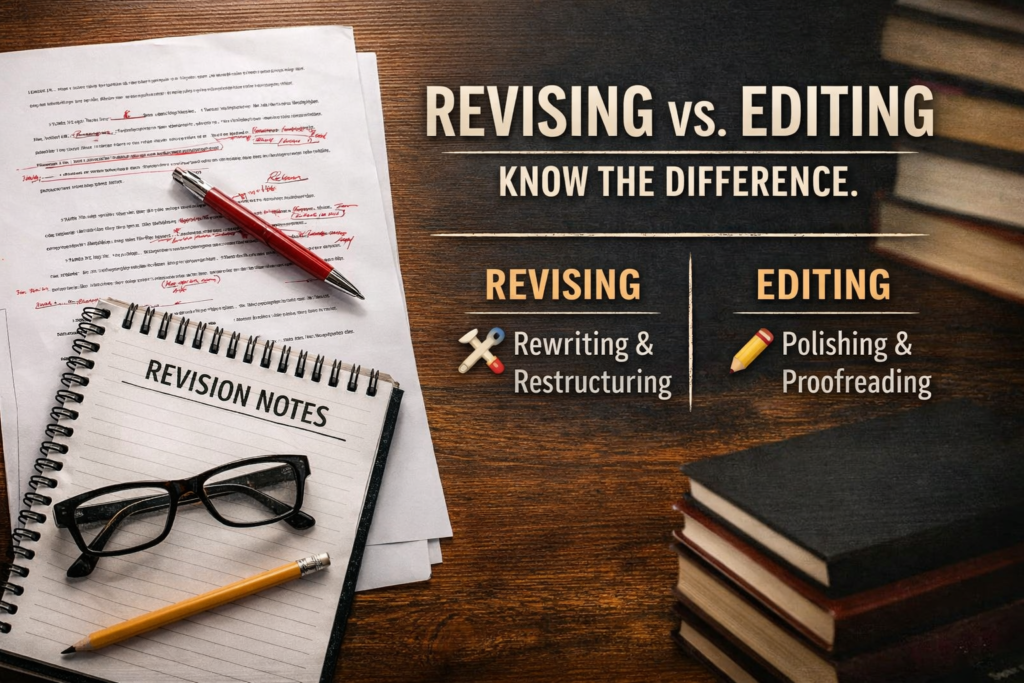
One of the most common misunderstandings among new writers is the difference between revising and editing. Many writers think they’re the same thing. They aren’t. And confusing the two can cause serious problems when preparing a manuscript for an editor.
Drafting Is Discovery
The first draft of a novel is usually an act of discovery. You’re figuring out:
- What the story really is
- Who the characters are
- What the conflict means
- How everything fits together
This is messy work. First drafts are supposed to be messy.
Revision Is Rewriting
Revision is where the real writing begins. This is when you step back and ask bigger questions:
- Does the story start in the right place?
- Does the protagonist have a clear goal?
- Are the stakes high enough?
- Does every scene move the story forward?
Revision often means rewriting entire sections of the book. Scenes may be cut. New scenes may appear. Characters may change dramatically. Sometimes the entire structure of the story shifts.
This isn’t editing. This is rebuilding the story so it works.
Editing Is Refinement
Editing happens after revision. Once the story structure works, editing focuses on improving the writing itself:
- Clarity
- Flow
- Dialogue
- Word choice
- Sentence rhythm
This is where an editor helps polish the manuscript so it reads smoothly and professionally.
Why the Difference Matters
Sending a manuscript to an editor before revising it properly is like asking a painter to polish the windows of a house that hasn’t been built yet.
Editors can improve sentences. They can strengthen paragraphs. But they cannot fix a story that hasn’t been fully developed. That work belongs to the author.
The Real Workflow
A healthy writing process usually looks like this:
Draft → Revise → Revise again → Then edit.
Writers who understand this sequence produce much stronger manuscripts.
And editors everywhere silently thank them.
–Mark