storytelling

Miscellaneous

The Comfortable Manuscript Problem

There’s a point in many manuscripts where the story quietly pulls back. The conflict softens, the dialogue becomes safer, and characters make the reasonable choice instead of the revealing one. The result is a manuscript that is technically good—but often forgettable. The moments readers remember are rarely the comfortable ones.

Plotting, Stakes

The #1 Problem I See in Manuscripts Right Now

The most common problem I see in manuscripts right now isn’t bad prose or weak dialogue. It’s stories where the protagonist could simply walk away—and nothing meaningful would happen. If your character can shrug and go home, they probably should. So why don’t they?

Character

Why Stand By Me Still Works (When So Many Stories Don’t)

Why does Stand By Me still hit forty years later when so many stories vanish almost as soon as the credits roll? Because it isn’t built on spectacle or plot twists. It’s built on emotional truth. Four boys, one long walk, and a story that trusts us to care about the people more than the destination. That’s a rare thing. And maybe that’s why it still works.

Editing

Why Good Editing Feels Invisible

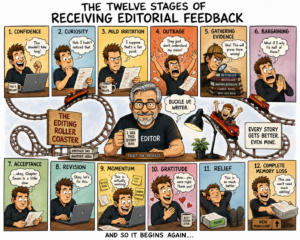
Good editing doesn’t draw attention to itself. When it works, readers never notice it at all — they simply fall into the story. Editing isn’t about rewriting an author’s voice or showing off clever fixes. It’s about removing the friction that causes readers to hesitate, lose momentum, or quietly stop turning pages.

Miscellaneous

Anyone Quoting Black-and-White “Rules” About Writing Is Full of Crap

If someone is handing you absolute, black-and-white “rules” about writing, they’re full of crap.
Most of those commandments started life as reasonable cautions… before nuance died somewhere between a conference panel and a poorly edited podcast rant.

Real editors don’t enforce rules.
Real editors ask one question: Is this working for this story, this audience, this moment?

Follow every so-called rule perfectly and you won’t write a great book — you’ll just write a technically correct, emotionally flat one.
Rules can stop you from making mistakes.
They cannot help you make choices.
And writing is nothing but choices.

Character, Dialogue, Voice

Mind Your @#$%& Mouth: Swearing in Fiction (And How Not to Mess It Up)

Writers love to worry about swearing — usually more than their characters do. The truth? Profanity isn’t “good” or “bad.” It’s a tool. A sharp one. Used well, it cuts cleanly through tension, reveals character, or snaps a moment into focus. Used poorly, it just bleeds all over the page.
In this post, Mark breaks down when swearing works, when it absolutely doesn’t, how genre affects your choices, and why every curse word has to be earned. If your characters are going to swear, make sure they mean it.

Voice

Trust Your Readers (They’re Smarter Than You Think—Usually)

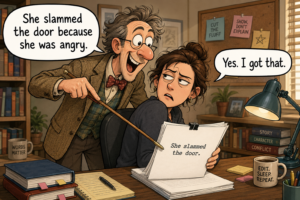
Readers aren’t toddlers in need of hand-holding—they’re highly skilled story-decoders who’ve been reading between the lines since grade school. They don’t need your theme underlined, highlighted, and surrounded by interpretive dance. In fact, the moment you over-explain, you kill the magic. Trust them to catch the subtext, feel the tension, and assemble the clues. Not only will your story be stronger for it—your readers will love you for letting them play along.

Plotting, Suspense, Thrillers

Old School vs New School Spy Thrillers

There was a glorious time — not as far back as dinosaurs, but far enough that you had to physically turn a page — when spy thrillers were built on tension. Real tension. The slow-burn, creeping dread variety that made you lean forward until you realized your spine was doing yoga poses you didn’t sign up for.

These were the days of The Bourne Identity, the early Bond novels, and le Carré’s Tinker, Tailor, Soldier, Spy — stories powered by paranoia, not pyrotechnics. Today, spy thrillers have traded that slow dread for weaponized anxiety and smartwatch hacking. But both eras have something to teach us about how to build suspense that sticks.

Character

The Power of Knowing Your Character’s Arc (Before You Start Writing)

Writing a story without understanding your main character’s arc is like driving cross-country blindfolded — you might arrive somewhere, but odds are it won’t be where you meant to go. Every protagonist travels an emotional and psychological path, changing (or refusing to change) because of the story’s events. When you understand that inner journey — and how it collides with the outer, plot-driven one — every scene gains purpose, every choice deepens meaning, and your rewrite count drops dramatically. Know your hero’s lie, the truth they need to learn, and what the story will throw at them to force that transformation. Everything else flows from there.Is this conversation helpful so far?

Character, Conflict

The Bigger They Are…

A “reasonable” villain might seem believable—but it’s also the fastest way to kill tension in your story. The best antagonists aren’t fair opponents; they’re towering, terrifying forces that make the hero dig deep and evolve. From Goliath to the Borg, it’s the impossible odds that make victory unforgettable.

Character, Conflict

The Two Sides of Conflict: Why Your Story Needs Both

Conflict is the heartbeat of fiction—but not all conflict is created equal. External conflict drives your plot forward, while internal conflict drives your character’s growth. When you make those two forces feed each other, your story hits harder and lingers longer.

Plotting

Mastering the Scene: Why Your Novel Depends on It

A novel isn’t a pile of words—it’s a chain of well-built scenes. This post breaks down the five parts of a powerful scene (from Inciting Incident to Resolution) and why scene craft is the difference between a draft and a publishable book.

Scroll to Top