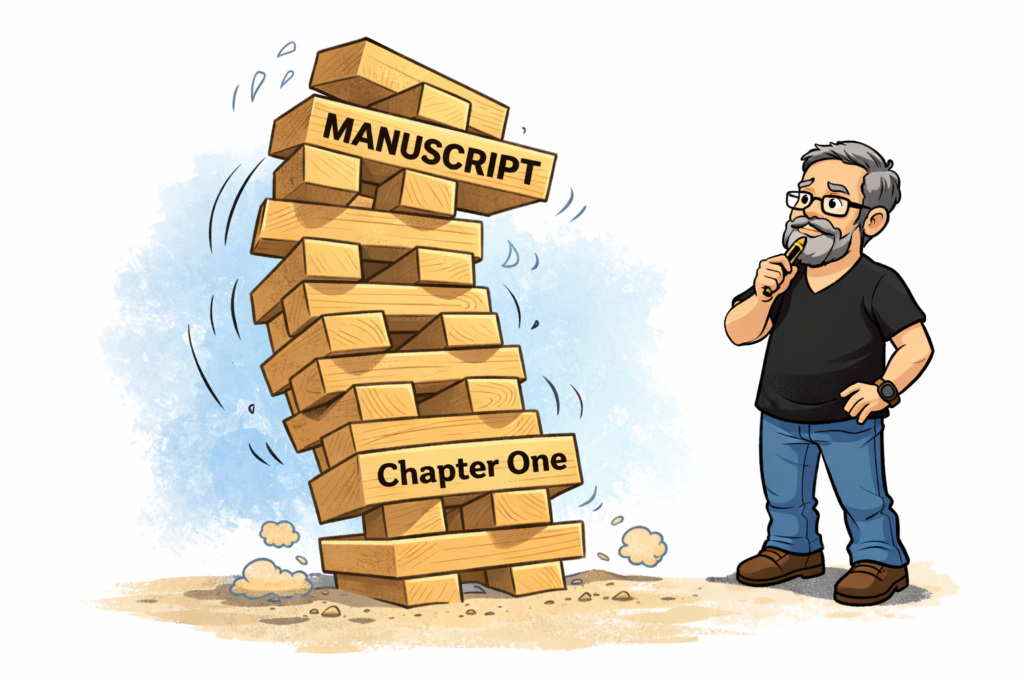
Let me reassure you of something right up front: Most manuscripts don’t fail because the author lacks talent. They fail because Chapter One doesn’t do its job. That’s a very different problem.
After editing a great many manuscripts over the years, I can tell you that when a story struggles, the issue almost always reveals itself within the first few pages. Not because the writer can’t write, but because they haven’t yet learned what Chapter One is for. It is not:
- A warm-up lap.
- A weather report.
- A backstory dump.
- A character biography.
- A slow clearing of the throat before “the real story” begins.
Chapter One is a promise. It tells the reader what kind of experience they’re about to have. If you’re writing a thriller, Chapter One should create unease, instability, danger, or at least the promise of motion.
If you’re writing romance, Chapter One should establish emotional stakes, longing, tension, or chemistry. If you’re writing science fiction, Chapter One should make it unmistakably clear that we are not in Kansas anymore — even if Kansas technically still exists.
What most manuscripts do instead is this: They introduce a character having a perfectly ordinary day. Nothing is wrong. Nothing is at risk. Nothing is changing. Which leaves the reader asking the most dangerous question in fiction: Why am I here?
You don’t need explosions in Chapter One. (Despite what some thriller writers believe.) But you do need disruption. Something must be off-balance.
- A question must be raised.
- A problem must be hinted at.
- A threat must be felt.
- A desire must be frustrated.
If Chapter One feels calm, symmetrical, and comfortable, the manuscript is already in trouble. Because readers don’t turn pages to preserve equilibrium. They turn pages to see what breaks.
The second reason manuscripts fail in Chapter One is clarity. The reader should know:
- Whose story this is.
- What kind of story it is.
- What emotional tone they’re settling into.
- Where we roughly are.
- And what matters.
Confusion is not intrigue. Mystery is intentional. Confusion is accidental. They are not the same thing.
And finally — stakes. Even if the stakes are small at first, they must exist.
- A missed phone call can be a stake.
- A delayed train can be a stake.
- A lie can be a stake.
But it must matter to someone. If it doesn’t matter to the character, it won’t matter to the reader.
The good news? These are structural problems, not creative failures. They can be fixed.
Chapter One is not about showing everything you know about your world. It’s about showing enough to make the reader lean forward. And once they lean forward? You’ve done your job.
—
If you’re working on a manuscript and you suspect your Chapter One might be doing throat-clearing instead of storytelling, that’s fixable.
Before you polish sentences, fix structure. Before you tweak dialogue, clarify stakes. Before you add more description, ask: What changes in this chapter? If the answer is “nothing yet,” that’s where you start.
— Mark
SRP Editor